People ask me this question a lot. Usually after they've tried one of our biscotti for the first time and said something like — "wait, this is different from what I've had before."
Yes. It is different. And I'm going to tell you exactly why.
I'm Antonio Russo. I grew up in Naples. My father Palmiro is an award-winning pastry chef who has been baking for over fifty years — and his family is still in Italy, still in the baking industry, still using the same recipes that have been passed down through generations. Those recipes are what we bake here in Petaluma, California. So when someone asks me the difference between Italian biscotti and American biscotti, I'm not speaking from a cookbook. I'm speaking from fifty years of family history and the clear memory of what a proper biscotto tastes like.
Here is my honest answer.
1. Size — Italian Biscotti Are Smaller, Bite-Sized
This is the first thing most people notice when they open a package of authentic Italian biscotti for the first time. They're smaller than what you see in American coffee shops.
That's by design. Traditional Italian biscotti are meant to be one or two bites. You dip, you eat, you dip again. The size is calibrated to the ritual — small enough to hold comfortably between your fingers, small enough to fit the proportion of coffee in your cup, small enough that you finish one before it gets soft and reach for another.
American biscotti grew in size to become a standalone treat. When you're selling something as a meal replacement or an afternoon snack rather than a coffee companion, bigger makes sense commercially. But the size changes the experience completely. A large biscotto dipped in espresso collapses before you finish eating it. A properly sized Italian biscotto is in and out of the cup in seconds.
Our Whole Almond Biscotti are sized the traditional Italian way — smaller, balanced, made for the cup they're meant to be dipped into.

2. Texture — Crisp, Not Hard
Let me clear something up because I hear this complaint all the time: authentic Italian biscotti are not supposed to be teeth-breaking hard.
Crisp is the right word. There's a clean snap when you break one. There's genuine resistance when you bite in. But there should never be pain involved, and anyone selling you something that feels like a brick is not giving you a proper biscotto — they're giving you something that went wrong and calling it traditional.
The twice-baked process — bis coctum, baked twice, which is literally where the word comes from — creates a very specific texture. The first bake sets the structure. The second bake, slower and lower, draws out moisture and creates that crispness. Done correctly, the result is a biscotto that is firm enough to hold up when dunked in espresso without dissolving, but not so dense that it becomes a chore to eat.
At True Delicious, we describe it as crisp, never too hard. Our customers use the same language again and again in their reviews without being prompted. That's how we know we're getting it right — because it matches what authentic Italian biscotti are supposed to feel like.
3. Ingredients — Higher Percentage of the Good Stuff
Pick up an American mass-market biscotti and look at the ingredient list. You'll often find the featured ingredient — almonds, cranberries, chocolate — somewhere in the middle of a long list. The first ingredients are typically flour, sugar, and various starches or stabilizers. The hero ingredient is a supporting actor.
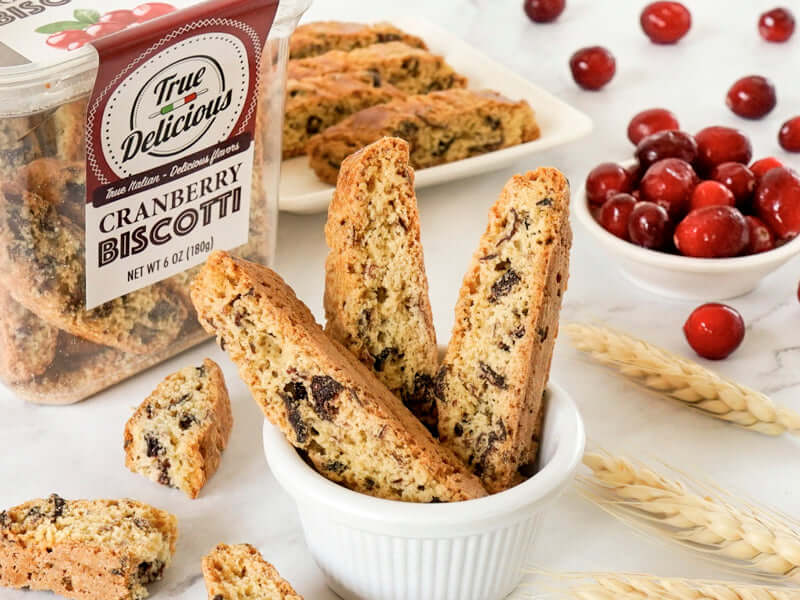
In authentic Italian biscotti, the main ingredient is actually present in meaningful quantity. Our Cranberry Biscotti list cranberries as the second ingredient on the label. When you bite into one, you taste cranberry — real, tart, present cranberry — because there's enough of it to matter. Our Salted Pistachio Biscotti are loaded with real California pistachios. Our Whole Almond Biscotti use whole almonds that you can see and taste in every bite.

This is a philosophy as much as a recipe decision. If almond is the hero of the biscotto, almond should taste like the hero. Everything else is supporting it, not diluting it.
4. Handcrafted in Small Batches vs. Factory Made
There is a category of biscotti that is made in enormous industrial quantities, packaged for year-long shelf life, and distributed to grocery stores across the country. These biscotti are shelf-stable because they have to be — they might sit in a warehouse for months before they reach a store, and then sit on a shelf for months more.
The biscotti my family makes in Petaluma work on a different timeline. We bake in small batches. Orders ship the next business day. What arrives at your door is fresh from the bakery — not from a distribution center.
Small-batch baking is slower. It doesn't scale the way a factory does. But it means that every batch gets attention that a factory line cannot give. My father's standards are present in every bake because our operation is small enough that standards can actually be maintained. That's not something I say for marketing purposes — it's the practical reality of how small-batch food production works versus industrial production.
5. Natural, Local Ingredients vs. Mass-Produced and Over-Refined
My father taught me that the ingredient is the flavor. Not the flavoring — the ingredient.
We use whole California almonds because California grows excellent almonds and whole means the flavor is intact. We use real orange purée in our Orange Chocolate Chip Biscotti , real orange. We use Guittard chocolate because it's a San Francisco institution with a real product.
Mass-produced biscotti often rely on artificial flavoring because artificial flavoring is cheaper, more consistent at scale, and has a longer shelf life than real ingredients. An artificial almond flavor will taste the same in batch one million as it did in batch one. A real almond will have slight variations based on the harvest — and that's a feature, not a bug.
All True Delicious biscotti are made with 100% non-GMO ingredients. No preservatives. No artificial flavors. No artificial colors. The ingredient list on our packaging reads like something your grandmother would recognize, because it is.
6. One Hero Ingredient — Italian Biscotti Don't Try to Do Everything
This is something I feel strongly about and rarely see discussed.
Authentic Italian biscotti are built around one main ingredient. Almond biscotti are about the almond. Anise biscotti are about the anise. Hazelnut biscotti are about the hazelnut. The other ingredients exist to support and frame the hero — not to compete with it.
American biscotti sometimes try to do too much. Chocolate chip cranberry orange almond biscotti — every flavor at once, fighting for attention. You end up tasting nothing distinctly because everything is present in equal, diluted measure.
The Italian approach is more restrained and, I think, more honest. Decide what this biscotto is about. Make that ingredient count. Let it speak.
When you eat our Whole Almond Biscotti, you taste almond. Clean, roasted, real almond — present from the first bite to the last. That clarity of flavor is only possible when you commit to the hero ingredient and resist the temptation to add more.
7. Vin Santo, Wine, and the Full Italian Picture
Here is something most Americans don't know: biscotti were not originally invented for coffee.
The traditional Tuscan pairing is cantuccini — the original Italian biscotti — dunked in Vin Santo, a sweet dessert wine. You finish a meal, someone brings out a small glass of Vin Santo and a plate of biscotti, and you spend the next thirty minutes at the table talking, dipping, and slowly finishing both. It's a dessert and a social ritual at the same time.
The coffee pairing came later and is genuinely Italian — espresso and almond biscotti is a legitimate tradition in its own right. But knowing that biscotti were originally a wine companion changes how you think about them. They are not a coffee shop accessory. They are a food that has been part of Italian table culture for centuries, adaptable to different occasions and different drinks.
At home, try our biscotti with a sweet wine or a glass of dessert wine after dinner. The crispness that seems unusual on its own becomes exactly right when you're dunking into something slow and sweet.
8. Authenticity — Our Family Is Still There
I want to say something about authenticity that goes beyond marketing language.
My father's family is still in Italy. They are still baking. The recipes we use at True Delicious are not adaptations of Italian recipes — they are Italian recipes, maintained by the same family over generations, brought to California by people who grew up making them.
That's a different kind of authenticity than a company that studied Italian baking and created something Italian-inspired. We didn't study it. We lived it. My father learned from his father. Those recipes came with him when he came to California. They haven't changed because there's no reason to change something that's already right.
When I say authentic Italian biscotti, I mean biscotti that an Italian family would recognize as their own — not because they're made in Italy, but because the knowledge and tradition that makes them what they are traveled across the ocean with the people who made them.
9. Non-GMO and Natural vs. Artificial
Artificial flavoring exists to simulate the taste of a real ingredient at a fraction of the cost. It's efficient. It's consistent. It is not food in the way I understand food.
My father's generation did not use artificial flavoring because it didn't exist yet. They used what grew around them — almonds from the trees, citrus from the garden, anise from the market. The flavor came from the ingredient itself, not from a chemical approximation of it.
All True Delicious biscotti are made with 100% non-GMO ingredients. We do not use artificial flavors, artificial colors, or preservatives of any kind. This is not a trend we adopted. It is how my family has always cooked, and it is the only approach I know how to stand behind.
You can taste the difference. Not because non-GMO is a magic quality — but because real ingredients taste like what they are, and artificial ingredients taste like an approximation of what they're pretending to be.

So Which Is Better?
I'm an Italian baker, so you know where my loyalty sits. But I'll be honest with you: American biscotti are genuinely enjoyable. They're sweeter, softer, more immediately satisfying to eat on their own. If you want a cookie to eat with your afternoon coffee without thinking about it too much, an American biscotti does the job.
What authentic Italian biscotti offer is something different — a connection to a tradition, a ritual, a way of experiencing coffee or wine that rewards a little patience and attention. They're not trying to be a standalone indulgence. They're trying to make whatever you're drinking better. That's a quieter ambition, and I think it's a more honest one.
If you've only ever had American biscotti, I'd genuinely like you to try the Italian version. Not because one is objectively superior, but because the Italian version tells a different story — and it's a story worth knowing.
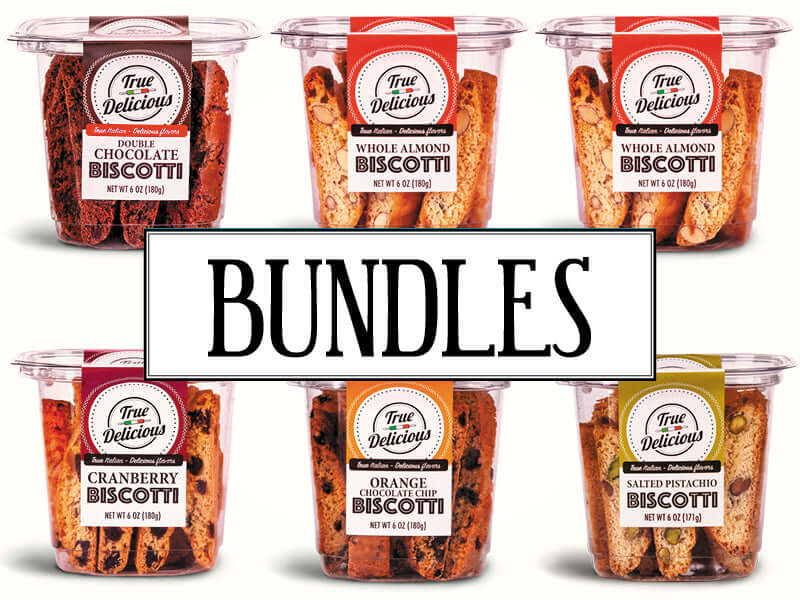
Browse our full collection at truedelicious.com/collections/authentic-italian-biscotti. Not sure where to start? Our All Flavors Biscotti 8-Pack lets you try every flavor at once — the best way to find your favorite before committing to a subscription.
Build your own bundle and save up to 25% with a monthly subscription. Free shipping on all orders over $50.
True Delicious Italian biscotti are handcrafted in Petaluma, California by Italian bakers using traditional family recipes passed down through generations. 100% non-GMO. No preservatives. No artificial flavors. Shipped fresh nationwide.